
SEO Group
Blog
7 minutes read
March 9, 2026
Yes, but only when they’re done with a clear purpose. For most service businesses, the primary SEO goal is to rank their core service pages. Blog posts usually won’t replace those pages, but they can support them — and when done well, they expand your reach in ways service pages alone can’t. That distinction matters,
Yes, but only when they’re done with a clear purpose.
For most service businesses, the primary SEO goal is to rank their core service pages. Blog posts usually won’t replace those pages, but they can support them — and when done well, they expand your reach in ways service pages alone can’t.
That distinction matters, because it’s where most service businesses go wrong. They either dismiss blogging entirely as a waste of time, or they publish endlessly without asking whether any of it is helping. Getting the balance right is a core part of what our Digital Marketing services are built around.
This guide covers how blogging and SEO actually work together for service businesses, what makes a blog post worth publishing, and why quality matters far more than quantity.
Do Blog Posts Help SEO for Service Businesses? The Short Answer
Yes — but as a supporting asset, not a replacement for your service pages.
Your service pages are where conversions happen. They target the commercial keywords your customers search when they’re ready to buy: “family lawyer Melbourne,” “outsourced bookkeeping services,” “emergency plumber Sydney.” Those pages need to rank, and they should be the priority.
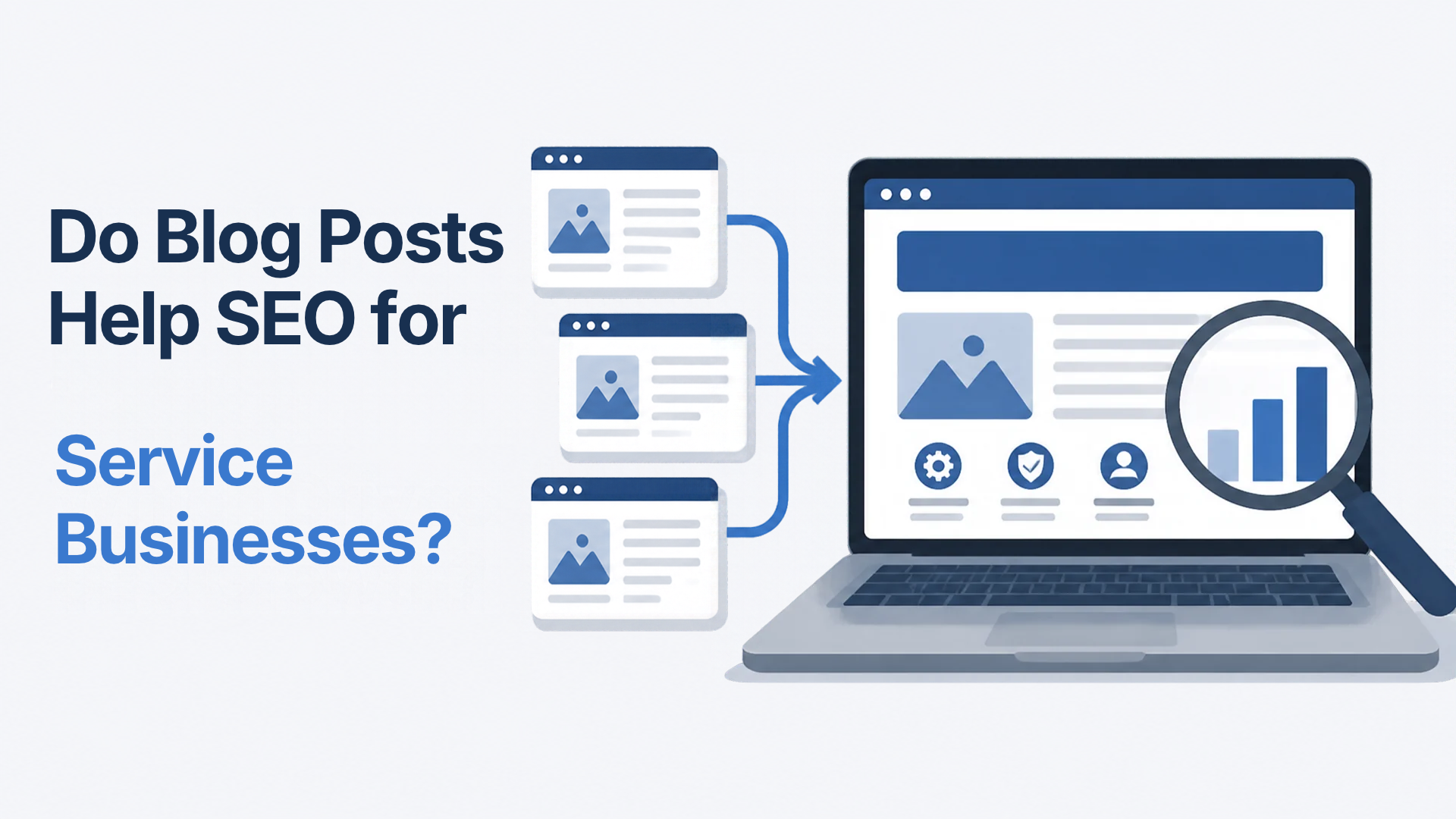
Blog posts operate one step earlier in the journey. They target the questions people ask before they’re ready to hire — and they build the topical authority that helps your service pages rank in the first place.
In other words: service pages convert, blog posts attract. You need both working together.
How Blog Posts Support Your Core Service Pages
A well-executed blog doesn’t compete with your service pages — it strengthens them. Here’s how:
They expand your keyword reach. Your service pages can only target so many terms before they become unfocused. Blog posts let you cover the long-tail questions your customers search — the ones your service pages would never rank for on their own.
They build topical authority. Google rewards sites that demonstrate depth on a subject. A cluster of genuinely useful articles around your service area signals expertise in a way a single service page cannot.
They create internal linking opportunities. Every blog post is a chance to link back to your service pages with relevant anchor text — one of the clearest signals you can send about which pages matter most.
They capture early-stage researchers. Someone reading “how child custody works in Australia” isn’t ready to hire a lawyer yet. But when they are, the firm that answered their question is the one they remember.
What Makes a Blog Post Worth Publishing
A good blog post targets questions your potential customers are already searching for.
For example, a family lawyer might write about “how child custody works in Australia” or “what happens during divorce mediation.” These topics attract people who are still researching, and some of them will eventually need the service.
The key word is already. You’re not inventing topics — you’re answering questions that exist in search data. Tools like Google’s “People Also Ask,” Search Console query reports, and your own sales team’s FAQ list will tell you exactly what your customers want to know.
A useful test before publishing: would a real customer find this genuinely helpful, or is it just filling a slot in your content calendar?
Why Quality Matters More Than Quantity
This is where most service business blogs fail.
At one point, we unpublished more than 80 blog posts from our agency’s website because they were written just to “produce content.” The content was average, and it didn’t generate any significant amount of traffic.
That experience shaped how we think about blogging and SEO. Volume without purpose doesn’t just fail to help — it can actively work against you. Thin, generic posts dilute your site’s quality signals, compete with each other for the same keywords, and give visitors no reason to trust you.
Google’s guidance on helpful content is explicit: it rewards content created to help people, not content created to manipulate rankings. A smaller library of genuinely useful articles will outperform a large library of average ones every time.
We cover this in more depth in our article about [the role of helpful content in SEO].
How to Choose Blog Topics That Actually Rank
A practical framework for service businesses:
-
Start with real customer questions. What does your sales team get asked every week? What comes up in consultations? Those are your topics.
-
Check search intent. Is the searcher looking for information, comparison, or a provider? Match your content to the intent — an informational query needs a guide, not a sales pitch.
-
Look at what already ranks. If the top results are thin or outdated, there’s an opening. If they’re comprehensive guides from major sites, you need a genuinely better angle.
-
Connect every post to a service page. If a topic doesn’t naturally link to something you sell, question whether it belongs on your blog.
-
Prioritise depth over frequency. One thorough, well-researched post per month beats four shallow ones.
If you want a structured process for this, our Digital Marketing services include SEO and content strategy built around exactly this approach — real customer questions, mapped to service pages, with monthly reporting.
Common Blogging Mistakes Service Businesses Make
-
Publishing for volume. A content calendar filled for the sake of it produces exactly the kind of average posts we unpublished.
-
Never linking to service pages. A blog post that doesn’t connect back to what you sell is a missed opportunity.
-
No author credibility. Service businesses sell expertise. Anonymous posts undermine that — attach a named author with real credentials.
-
Ignoring search intent. A sales-heavy post targeting an informational query will underperform, no matter how well written.
-
Abandoning it after three months. Blogging and SEO compound over time. Most meaningful results take six to twelve months of consistent effort.
-
Not measuring anything. Track which posts bring traffic, which generate enquiries, and which do neither. Then act on it.
If content production is where your team gets stuck, a dedicated virtual assistant can handle research, drafting support, and publishing workflow under your editorial direction — keeping the blog consistent without pulling your team away from billable work.
FAQ
Do blog posts actually help SEO for service businesses?
Yes — as a supporting asset. Blog posts expand your keyword reach, build topical authority, and create internal linking opportunities that help your core service pages rank. They rarely replace service pages, but they make them stronger.
How often should a service business publish blog posts?
Consistency matters more than frequency. One well-researched, genuinely useful post per month is a sustainable cadence for most service businesses — and it will outperform a higher volume of average content.
How many blog posts do I need before SEO results show?
There’s no fixed number. Results depend on competition, content quality, and technical foundations. Most businesses see meaningful traction after six to twelve months of consistent, purposeful publishing.
Should every blog post link to a service page?
Not every post needs a hard sell, but every post should have a natural path back to a relevant service page. If a topic has no connection to what you sell, question whether it belongs on your blog.
Can blogging hurt SEO?
Poor-quality blogging can. Thin, generic posts published at scale dilute your site’s quality signals and compete with each other for the same keywords. Quality and purpose are what protect you.
What’s the difference between a blog post and a service page for SEO?
Service pages target commercial keywords and convert visitors who are ready to buy. Blog posts target informational queries earlier in the journey, build authority, and support service page rankings through internal links.
Want blog posts that actually support your service pages? Talk to our content and SEO team about a strategy built around real customer questions.
Share this Post
false