
SEO Group
Blog
7 minutes read
March 9, 2026
In many cases, not really. Most of the practices that help your content appear in AI-generated answers are already part of good SEO. Things like publishing content that clearly answers user questions, structuring information logically, and adding FAQ sections have been SEO best practices for years. So if someone is charging extra for “AEO” (answer
In many cases, not really.
Most of the practices that help your content appear in AI-generated answers are already part of good SEO. Things like publishing content that clearly answers user questions, structuring information logically, and adding FAQ sections have been SEO best practices for years.
So if someone is charging extra for “AEO” (answer engine optimisation) but is only doing those same things, you’re probably paying for work that should already be included in a solid SEO strategy.
That said, the AEO vs SEO conversation isn’t entirely a marketing invention. There are cases where additional work genuinely makes sense — and knowing the difference is how you avoid paying twice for the same job. Our SEO services are built around that distinction: doing the fundamentals properly, then adding only what your site actually needs.
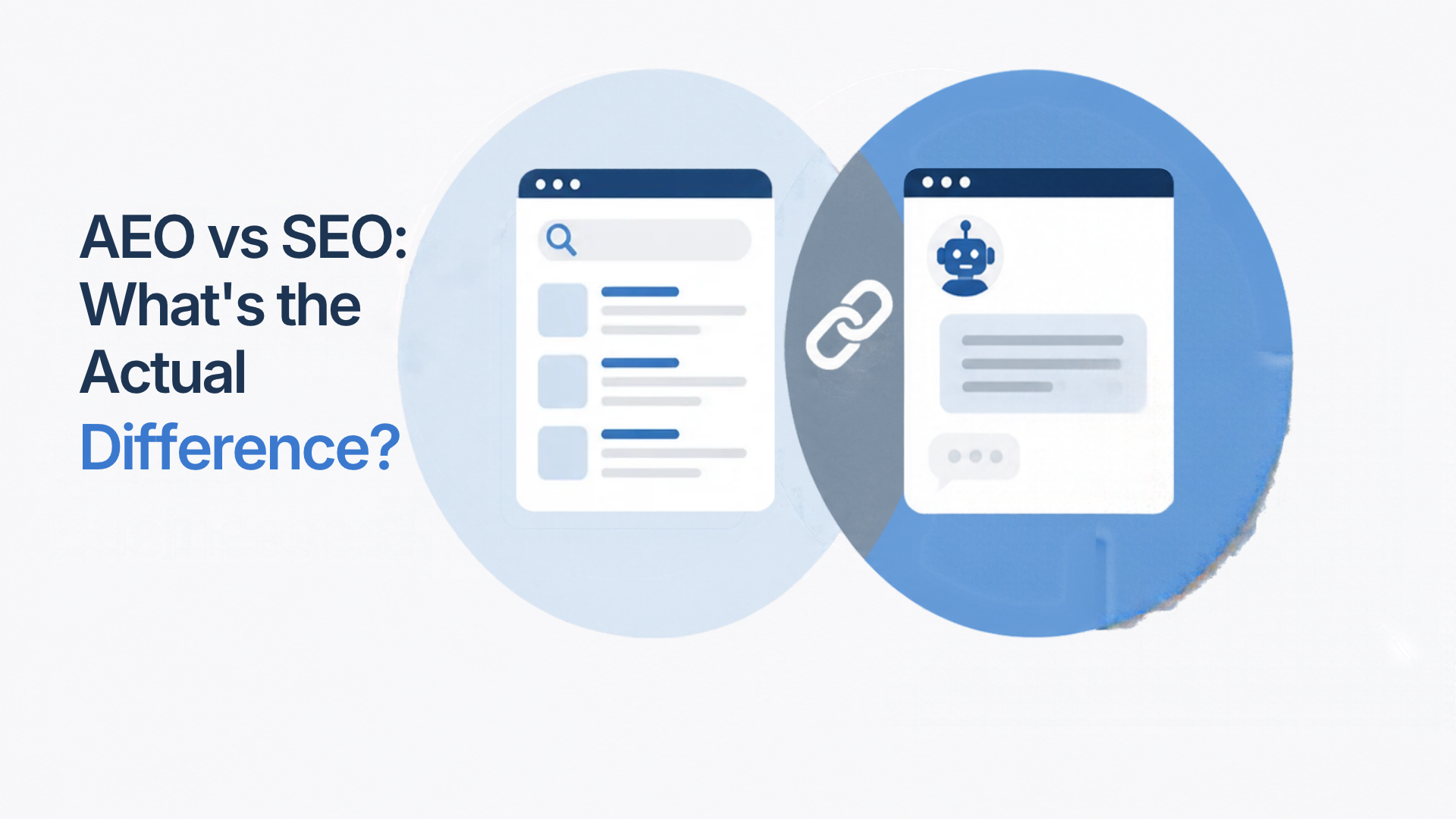
AEO vs SEO: What’s the Actual Difference?
SEO is the practice of improving your site so it ranks in traditional search results. It covers technical foundations, content quality, keyword targeting, internal linking, and authority building.
AEO — answer engine optimisation — is the practice of improving your content so it gets surfaced, summarised, or cited in AI-generated answers: ChatGPT, Google’s AI Mode, Perplexity, and similar tools.
Here’s the part most agencies don’t say out loud: the two overlap heavily. The content qualities that make a page rank well in Google are largely the same qualities that make it a good candidate for an AI answer — clear structure, direct answers to specific questions, credible sourcing, and technical accessibility.
The genuine differences are narrower than the marketing suggests. They come down to how AI systems discover, parse, and cite content — which is where the real AEO work sits.
Do You Need AEO If You’re Already Doing SEO? The Short Answer
For most businesses, no — not as a separate service.
If your SEO is genuinely solid, you’re already doing most of what AEO requires. The risk is paying a second time for work that should have been part of the first engagement.
But “most businesses” isn’t “all businesses.” The cases where AEO work is worth paying for are specific, and they’re worth understanding before you dismiss the category entirely.
The AEO Work That’s Already Covered by Good SEO
If your SEO provider is doing these things, you’re most of the way there:
Answering real user questions directly. Content that leads with the answer — rather than burying it after three paragraphs of preamble — is easier for both search engines and AI systems to extract.
Structuring information logically. Clear H2s, short paragraphs, and scannable formatting help AI tools identify which section answers which question.
Including FAQ sections. FAQs map directly to the question-answer format AI systems work in. This has been SEO best practice for years.
Demonstrating E-E-A-T. Named authors, cited sources, and genuine expertise make content more trustworthy — and AI systems are increasingly tuned to favour credible sources.
Maintaining technical health. Fast, crawlable, well-indexed pages are the baseline for both SEO and AEO.
If someone is charging a premium for “AEO” and the deliverables are only these five things, question the invoice.
When AEO Work Is Genuinely Worth Paying For
There are real gaps that standard SEO engagements often don’t cover:
Structured data implementation. Schema markup helps search engines and AI systems understand what your content is about and who it’s from. Many SEO retainers include basic schema but not comprehensive implementation across content types.
JavaScript and crawlability issues. If important content is rendered client-side or hidden behind JavaScript that crawlers struggle with, AI tools may not be able to read it at all. Fixing this is technical work that goes beyond standard on-page SEO.
Content discovery and citation strategy. Getting cited by AI systems sometimes requires work that isn’t purely on-site — building the kind of authoritative presence that AI models draw from. This is closer to digital PR than traditional SEO.
Monitoring AI visibility. Tracking whether and how your brand appears in AI-generated answers is a newer discipline with its own tools and methods. It’s genuinely additional work, not rebadged SEO.
If your provider can articulate these specific gaps and how they’ll address them, the AEO label is probably justified. If they can’t, it isn’t.
How to Test Whether Your Business Needs AEO
Here’s a simple, practical test you can run yourself in about ten minutes.
Ask about your brand, product, or industry in tools like ChatGPT or Google’s AI Mode. Try prompts a real customer might use:
-
“What’s the best [your service] in [your city]?”
-
“How does [your product category] work?”
-
“Who should I talk to about [your service]?”
Then assess what comes back:
-
Your business rarely appears — you may have a discovery gap worth addressing
-
Your business appears with inaccurate information — you have a citation and accuracy problem worth fixing
-
Your business isn’t mentioned at all — you may be invisible to AI systems, which is worth investigating
-
Your business appears accurately and often — you likely don’t need additional AEO work
This test won’t give you a complete picture, but it will tell you whether there’s a genuine problem to solve — which is more than most AEO sales pitches will do.
For a broader look at how AI is reshaping search, our article on whether AI-generated content is bad for SEO covers the quality side of the same shift.
What to Ask Before Paying for an “AEO Service”
A short checklist before you sign anything:
-
“Which of these deliverables aren’t already included in my SEO retainer?” If the answer is “none,” don’t pay extra.
-
“What specific technical issues will you fix?” Look for structured data, crawlability, and JavaScript rendering — not vague “optimisation.”
-
“How will you measure AI visibility?” There should be a method, not just a promise.
-
“Can you show me examples of clients cited in AI answers?” Ask for evidence, not case study language.
-
“What happens if nothing changes?” A provider confident in the work should be able to explain what success looks like and when.
FAQ
What is the difference between AEO and SEO?
SEO focuses on ranking in traditional search results. AEO focuses on being surfaced, summarised, or cited in AI-generated answers. In practice, they overlap heavily — most AEO fundamentals are already part of good SEO.
Do I need AEO if I’m already doing SEO?
For most businesses, no — not as a separate service. If your SEO is genuinely solid, you’re already doing most of what AEO requires. Additional work is only worth it for specific technical gaps or AI visibility problems.
Is AEO just a rebranded SEO service?
Sometimes. If a provider’s AEO deliverables are only answering questions, structuring content, and adding FAQs, those are standard SEO practices. Genuine AEO work involves structured data, crawlability fixes, and AI visibility monitoring.
How do I check if my business appears in AI search results?
Ask ChatGPT, Google’s AI Mode, or similar tools questions a real customer would ask about your service and location. Note whether your business appears, whether the information is accurate, and whether competitors are mentioned instead.
Will AI search replace Google SEO?
No. AI search tools draw heavily on indexed web content, and traditional search remains the dominant discovery channel. SEO fundamentals support both — which is why the distinction matters less than the marketing suggests.
How do I measure AEO success?
Track AI visibility separately from traditional rankings: whether your brand appears in AI answers for relevant prompts, whether the information is accurate, and whether citations increase over time. Traditional SEO metrics still apply alongside these.
Not sure whether you’re paying for AEO that’s already covered by SEO? Talk to our SEO team about what your site actually needs.
Share this Post
false